Boilers and heating for UK homes
Heating and boiler installation: from the boiler to the last radiator
A new boiler is only one part of the job. The rules in England also reach the controls, the radiator valves, the water inside the pipes, the flue and the carbon monoxide alarm, and a whole new system has to be designed to run cooler than most old ones did. This site sets out what a good installation includes, so the quotes you get can be judged on more than the price.
Get a heating quote What a quote should include
- 92% ErP efficiency at least
- Controls in each heated room
- CO alarm in the boiler’s room
- 30 days to get your certificate
Part by part
The seven parts of a wet heating system
Each number on the drawing above is one part of the system an installer touches when a boiler is replaced or a system is put in. Choose a number to jump to it here, or read straight through.
1The boiler
The heat source. In England a new gas boiler fitted in an existing home has to reach at least 92% ErP efficiency, and the controls that come with it count as part of the boiler installation.
Combi, system or regular2The controls
Time and temperature control and a boiler interlock as a minimum. A new gas combi also needs one of four extra measures, such as weather compensation or a smart thermostat that automates and optimises.
Heating controls3The radiators
When a boiler is replaced, each heated room should get its own temperature control where that is feasible. A newly installed or fully replaced system is designed to run at a flow temperature of 55°C or lower.
Radiators and flow temperature4The hot water cylinder
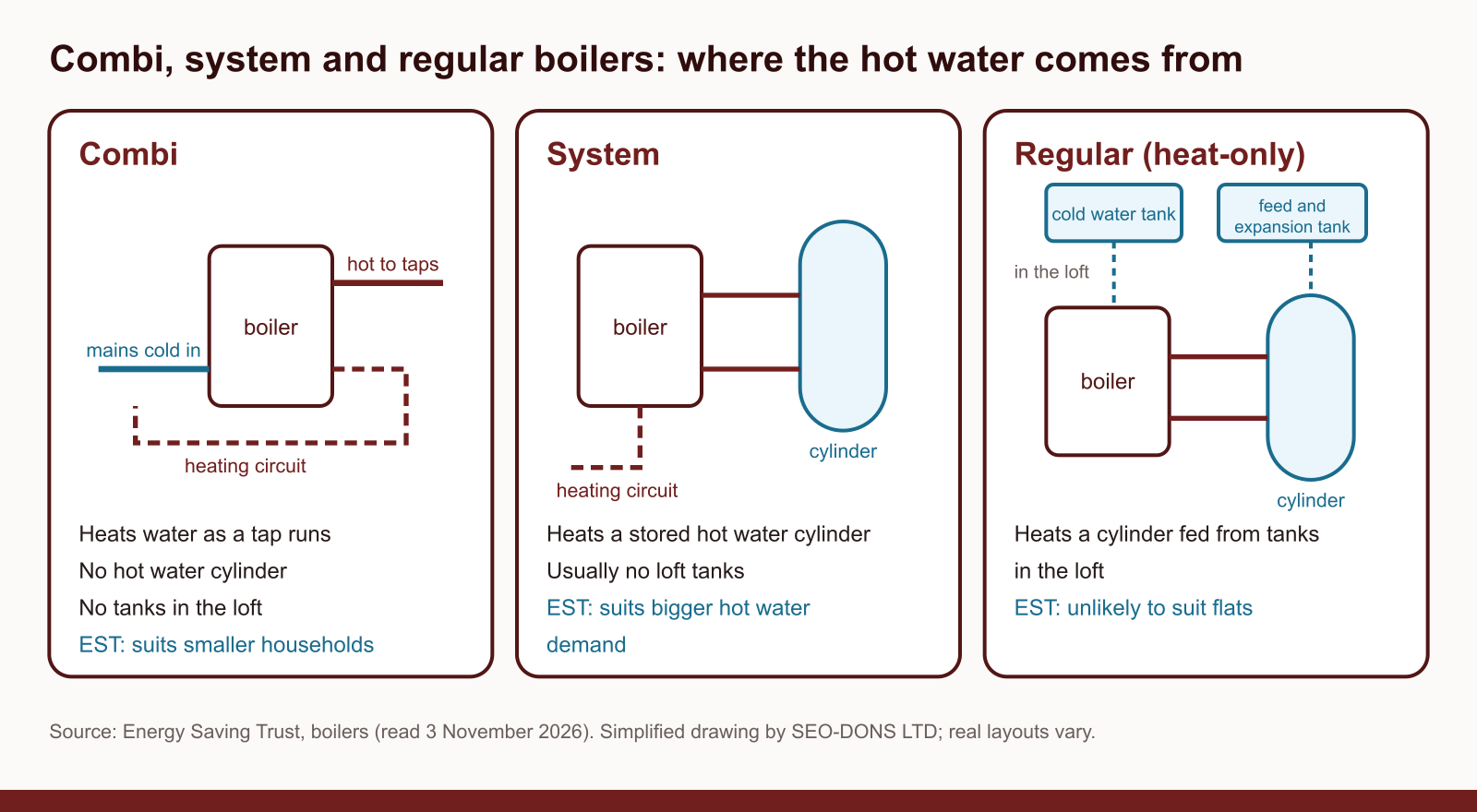
System and regular boilers heat water stored in a cylinder; a combi heats it as you run the tap. Fitting an unvented cylinder is notifiable work, done by someone who can show competence for it.
Hot water cylinders5The flue
Where the flue ends outside is fixed by minimum distances from windows, doors, corners, gutters, eaves and boundaries, and a condensing boiler’s plume can still trouble a neighbour.
Flues, condensate and CO alarms6The system water
Before a new boiler goes in, the circuits are cleaned and flushed and a chemical inhibitor is added; the system is then commissioned, and the Benchmark checklist can record it.
System cleaning and water treatment7The carbon monoxide alarm
In England a new or replacement gas boiler needs a carbon monoxide alarm in the same room, mounted at set distances from the boiler and the ceiling.
The CO alarm rule
The whole job
What a heating and boiler installation includes
Most people start by asking which boiler to buy. Installers who do the job well start somewhere else: how much heat the house loses on a cold day, how hot the water in the radiators needs to be to replace that heat, and how the boiler will be told when to run. The boiler is sized to the house, not the other way round. From 24 March 2027 England's rules say so plainly: sizing a replacement from the output of the boiler it replaces "is not appropriate", and a whole-house heat loss calculation is expected instead.
Around the boiler sit the parts that decide how well it works. The controls switch it on and off and, on a combi, must include one of four energy-saving measures. The radiators decide how cool the water can run, and a cooler system is a more efficient one. A hot water cylinder, if the house keeps one, is the second big load on the boiler. And the water in the pipes, cleaned and dosed with an inhibitor, decides how long everything lasts.
None of that is optional extra. When a boiler is replaced in England, the building regulations expect thermostatic control in each heated room where feasible, a boiler interlock so the boiler stops when no room or cylinder wants heat, separate timing for heating and hot water unless one controller already does both, and a system that has been cleaned, flushed and treated before the new boiler is commissioned. A quote that leaves these out is not a cheaper version of the same job; it is a smaller job.
Your kind of job
Three kinds of heating job, and what each one involves
Quotes for "a new boiler" can describe very different jobs. Before you compare prices, work out which of these three you are being quoted for.
| The job | What usually changes | What the rules add | Read more |
|---|---|---|---|
| The same type of boiler, in the same place | The boiler, its flue and controls; the system is cleaned and refilled | At least 92% ErP efficiency; the required controls; cleaning, inhibitor and commissioning; a CO alarm | New boiler installation |
| A different type of boiler | Pipework near the boiler, and often a cylinder or loft tanks taken out or added | The same as a like-for-like swap, plus any cylinder work: an unvented cylinder is notifiable | Combi, system or regular |
| A whole new or fully replaced system | The boiler, every radiator and the pipework | Designed for a flow temperature of 55°C or lower; sized from a heat loss calculation | Central heating installation |
Same type, same place
The shortest job, and the one most quotes describe. The old boiler comes off the wall, the new one goes up where it was, and the flue, condensate pipe, gas and water connections are made good. Even here the job is larger than the boiler: the controls come with it, the system is flushed and dosed, and a carbon monoxide alarm goes in the same room. If the old boiler was not a condensing one, the condensate pipe and its route to a drain are new work too; the flue and condensate article explains why the route matters in a frost.
A change of type, or a whole system
Swapping a regular boiler and its loft tanks for a combi, or a combi for a system boiler and cylinder, changes how the house gets its hot water. Ask what happens to the old tanks and cylinder, and whether the hot water you get afterwards suits the number of bathrooms. A whole new system goes further again: the radiators are chosen for a lower water temperature, which can mean larger ones in some rooms. The page on boiler types and the one on the 55°C design rule go into each choice.
The rules
What England requires, now and from 24 March 2027
Three sets of rules meet in a boiler installation. Gas safety law decides who may do the work: only a business on the Gas Safe Register, and an engineer whose ID card lists the right categories. The building regulations decide what the finished job must achieve, and Approved Documents L, J and G set out how to meet them in England. Consumer law decides what you are owed as a customer.
Most gas boiler work is self-certified. A business on the Gas Safe Register can sign off its own work without a building notice in advance, and must give you a compliance certificate, and tell building control, within 30 days of finishing. If a firm outside a scheme does the work, the firm or the householder has to notify the council before starting and pay its fee.
On 24 March 2027 a new edition of Approved Document L takes over in England. It keeps the 92% efficiency floor, the four combi measures and the 55°C design rule, and it is firmer about sizing a replacement boiler from a heat loss calculation. Our page on the installation rules sets out each rule and what changes.
Checks before you sign
Who does the work, and how to check them
- Gas work: look the business up on the Gas Safe Register, and read the back of the engineer's ID card, which lists the kinds of appliance they can work on. Pretending to be registered is itself an offence.
- Pipes and radiators: a plumber who is not on the Gas Safe Register can do this "wet work", but the boiler and its final water connection must be done by a registered engineer, who must not sign off anyone else's gas work.
- An unvented cylinder: fitting one is notifiable, and the installer shows competence through a scheme for that work or a current skills card.
- The contract: signed at home or online, it can normally be cancelled within 14 days, and work should not start in that time unless you expressly ask for it. More in contracts and cancelling.
Cost
What a new boiler costs to put in
Price lists for boiler installation are easy to find and hard to trust: most come from firms selling the work. The one benchmark from a large consumer body is the Energy Saving Trust's: an average of £3,500 across Great Britain to replace a G-rated gas boiler with an A-rated one, with thermostatic radiator valves. That is one job type, not a range, and the Trust last updated the page in May 2026.
Your price moves with the job. A change of boiler type, moving the boiler, a new flue route, a cylinder, new radiators or a fuller set of controls each add work, and the quote should list each one so you can see what you are paying for. VAT on a gas boiler installation is normally charged at the standard rate of 20%. The page on boiler installation cost explains what moves a price and how to read one.
Funding
Grants, and what they do not cover
There is no general grant for a new gas boiler. The Boiler Upgrade Scheme in England and Wales funds heat pumps and biomass boilers, not gas boilers or hybrids: its £7,500 grant is for replacing fossil fuel heating with an air or ground source heat pump, fitted by an MCS certified installer who applies for it and takes it off the quote. The Warm Homes: Local Grant in England, run by councils for lower-income households, does not list gas boilers among its measures, and the Energy Company Obligation closes on 31 December 2026.
Where a gas boiler or central heating is installed with grant funding for someone aged 60 or over, or on certain benefits, in their main home, VAT on the grant-funded part can be 5% instead of 20%. If you are weighing a boiler against a heat pump, boiler or heat pump sets the costs, VAT and running costs side by side.
Looking ahead
Is a gas boiler still a sensible choice?
For many homes, yes, and nothing in the government's Warm Homes Plan sets a date to stop fitting gas boilers in existing homes. The plan expects heat pumps to become the natural choice when an old system reaches the end of its life, and the Future Homes Standard, which starts on 24 March 2027, makes low-carbon heating standard in new homes, not in the ones people already live in.
What has changed is how a good gas installation is judged. A boiler sized to the house, radiators that let it run cool, and controls that keep it modulating at low output all lower running costs now, and keep a heat pump possible later. If a future heat pump is likely, keeping or adding a hot water cylinder now can save refitting one; most heat pumps work with one. Read can you still fit a gas boiler? and what "hydrogen-ready" means.
A note on labels
What the marketing words mean
"A-rated" and "ErP": the efficiency figure on a boiler's label. In England a new gas boiler in an existing home must reach at least 92% ErP.
"Smart": only a smart thermostat with automation and optimisation counts as one of the four extra measures a new combi needs.
"Hydrogen-ready": most boilers can already burn a blend of up to 20% hydrogen, and the competition regulator secured undertakings from one maker over how it used the phrase. It is not a reason to pay more.
"Power flush": one way of cleaning a system. What the rules ask for is a cleaned and flushed system with an inhibitor, commissioned to the British Standard; see system cleaning.
Quote checklist
Check what your quote should show
Tick what your job includes. The checklist lists the lines a written quote should show, the paperwork to expect afterwards and the rules that apply in England. It works in your browser and nothing you tick is sent. For the full walk-through, see comparing heating quotes.
Lines the written quote should show
Paperwork to expect afterwards
Rules that apply
Questions people ask before they replace a boiler
What does a heating and boiler installation include?
More than the boiler. In England a replacement also brings the controls the rules require, temperature control in each heated room where feasible, a cleaned and flushed system with an inhibitor, a flue in a permitted position and a carbon monoxide alarm in the boiler’s room. A new or fully replaced system is also designed to run at a flow temperature of 55°C or lower.
Who is allowed to fit a gas boiler?
Only a business on the Gas Safe Register may do gas work, and that includes the boiler itself and its final water connection. A plumber who is not registered can run pipes and fit radiators. Check the engineer’s ID card for the categories of work they are qualified for.
How much does a new boiler cost to install?
The one benchmark from a large consumer body is the Energy Saving Trust’s average of £3,500 to replace a G-rated gas boiler with an A-rated one, with thermostatic radiator valves, across Great Britain. It covers that one job type. A change of boiler type, a move, a cylinder or new radiators all change the price.
Is there VAT on a new gas boiler?
Yes, normally at the standard rate of 20%. A reduced 5% rate applies only to the grant-funded part of a gas boiler or central heating installation in the main home of someone aged 60 or over or on certain benefits, who orders the work themselves.
Can I get a grant for a new gas boiler?
Not from the Boiler Upgrade Scheme, which funds heat pumps and biomass boilers, never gas boilers or hybrids. The Warm Homes: Local Grant in England does not list gas boilers among its measures either.
What paperwork should I get afterwards?
A Building Regulations compliance certificate within 30 days of the work being finished when the installer self-certifies through the Gas Safe Register, and the completed Benchmark commissioning checklist. Keep both: the Energy Saving Trust advises keeping the building regulations papers for when you sell.
Where this page's facts come from
- legislation.gov.uk — Gas Safety (Installation and Use) Regulations 1998, regulation 3 read 3 November 2026
- HSE — the Gas Safe Register and the engineer ID card read 3 November 2026
- HSE — who can do gas work, and the limits of "wet work" read 3 November 2026
- Gas Safe Register — find and check an engineer read 3 November 2026
- legislation.gov.uk — Building Regulations 2010, Schedule 3 (self-certification) read 3 November 2026
- legislation.gov.uk — Building Regulations 2010, regulation 20 (compliance certificates) read 3 November 2026
- GOV.UK — Boiler Plus policy review (PDF) read 3 November 2026
- GOV.UK — Approved Document L, Volume 1: dwellings, 2021 edition incorporating 2023 amendments (PDF) read 3 November 2026
- GOV.UK — Approved Document L, 2026 edition (applies from 24 March 2027) read 3 November 2026
- GOV.UK — Approved Document J, 2022 amendments (PDF) read 3 November 2026
- GOV.UK — Approved Document G, with 2024 amendments (PDF) read 3 November 2026
- Energy Saving Trust — boilers (secondary source) read 3 November 2026
- HMRC — VAT Notice 708/6: energy-saving materials and heating equipment read 3 November 2026
- GOV.UK — Boiler Upgrade Scheme: apply read 3 November 2026
- GOV.UK — Boiler Upgrade Scheme: what you can get read 3 November 2026
- GOV.UK — Warm Homes: Local Grant read 3 November 2026
- GOV.UK — Energy Company Obligation read 3 November 2026
- GOV.UK — Warm Homes Plan (January 2026, corrected March 2026), PDF read 3 November 2026
- legislation.gov.uk — The Building Regulations etc. (Amendment) (England) Regulations 2026 (SI 2026/335) read 3 November 2026
- GOV.UK — CMA: boiler brand changes its "hydrogen-ready" marketing after CMA action read 3 November 2026
- Benchmark — the commissioning checklist scheme read 3 November 2026
- legislation.gov.uk — Consumer Contracts Regulations 2013, regulation 36 read 3 November 2026
Want a quote for your heating?
Tell us what heats the home now and what you would like quoted: a boiler, radiators, controls, a cylinder or the whole system. We reply by email.
What happens next
- Your details go to SEO-DONS LTD, the company behind Heating and Boiler Installation.
- We read what you have sent about the house and its heating, and reply by email.
- Asking for a quote costs nothing and leaves you free to say no.